Pay for Outcomes, Not Effort: Why Agent Commerce Demands a New Payment Model
 J Nicolas
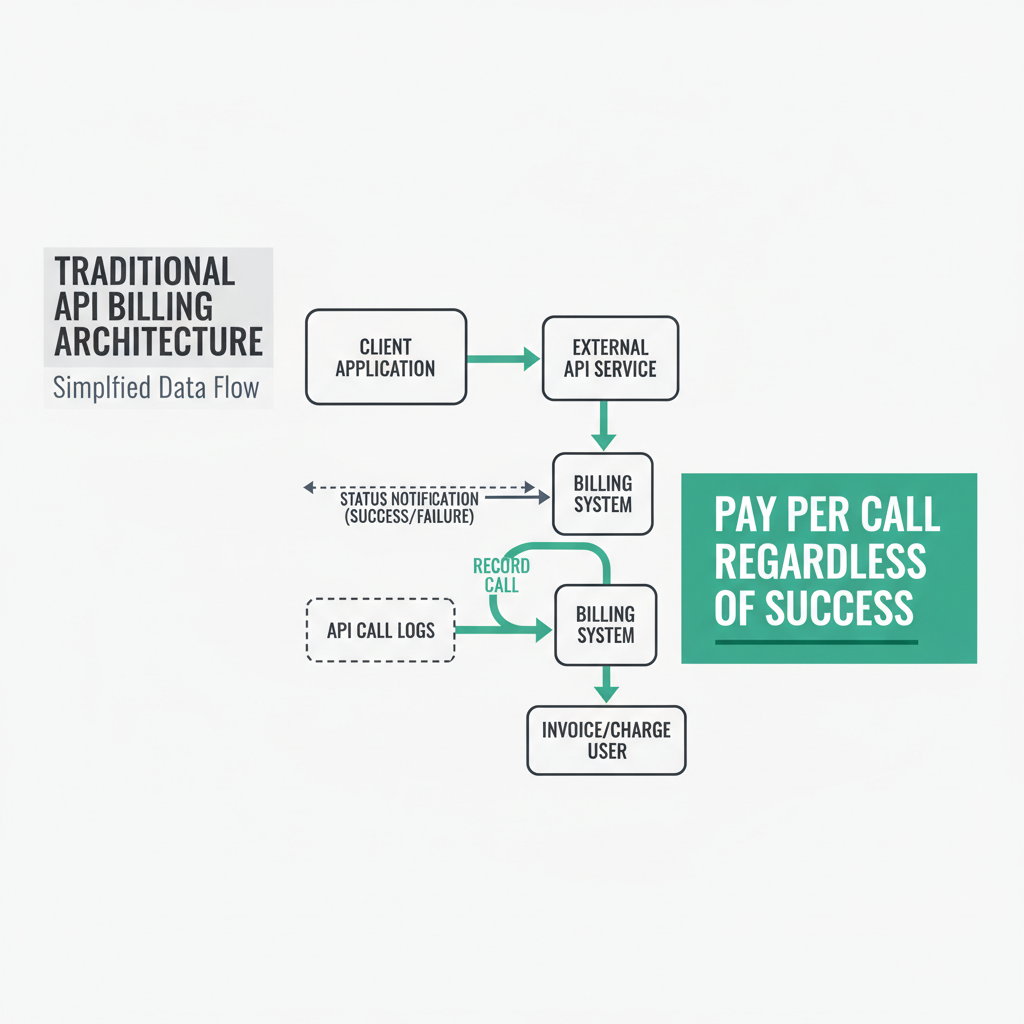
Most software payment models were designed for humans buying access to tools. You pay a monthly fee for a seat, or you pay per API call, and the vendor gets revenue regardless of whether the tool actually did anything useful. That model breaks when the buyer is an AI agent running thousands of tasks autonomously, where the cost of a failed call is just as real as the cost of a successful one.
Agent commerce needs a different model: payment tied to outcomes, not to the act of trying.
The Problem With Paying Per Call
Traditional API billing charges you for requests. Send a request, get charged. Whether the response contained useful data, whether the email got delivered, whether the phone number was valid — none of that affects the invoice. This works fine when a human is in the loop, checking results and deciding whether to try again. It works badly when an agent is making thousands of calls in an automated pipeline.
Consider a contact enrichment workflow. An agent queries a data API for 500 leads. 200 of those queries return empty results or stale data. Under per-call billing, you've paid for 200 failures. The vendor has no financial stake in the quality of what they returned. That misalignment is fine to tolerate at small scale. At agent scale, it compounds fast.
SaaS seat licenses are worse. You pay a flat monthly fee for access, regardless of how much value the tool generates. An agent that uses a tool heavily in one week and not at all the next still costs the same. There's no feedback loop between payment and value delivered.
The underlying issue is that both models treat payment as an access fee rather than a value exchange. When cognition becomes a commodity and agents are doing the buying, that distinction matters enormously.
What Outcome-Based Payment Actually Means
Outcome-based payment means the payment event is tied to a verified result, not to an attempt. The agent pays when the task completes successfully, and doesn't pay (or pays less) when it doesn't.
This sounds simple but requires a few things to work in practice:
- The agent needs to know the price before it commits to a task, so it can decide whether the expected outcome is worth the cost.
- Payment needs to happen at the moment of delivery, not on a billing cycle that lags days or weeks behind.
- Settlement needs to be verifiable on both sides without a human reconciling invoices.
- The whole loop needs to work programmatically, because there's no human approving each transaction.
This is exactly the problem the x402 protocol was designed to solve. It defines a payment flow where an HTTP 402 response tells the client the exact price and payment terms for a resource, the client pays in USDC on-chain, and the server verifies the payment before returning the result. The agent gets a quote, decides to pay, pays, and gets the outcome. No subscription, no post-hoc billing, no misaligned incentives.
How the x402 Flow Works
The x402 protocol adds a payment layer to standard HTTP. When a client requests a resource without payment, the server returns a 402 Payment Required response with a X-Payment-Requirements header describing what's needed: the price, the accepted token (USDC), and the network. The client constructs a payment, attaches it as an X-Payment header, and retries the request. The server verifies the on-chain payment and returns the result.
What makes this work for agents is that the entire flow is machine-readable. There's no checkout page, no OAuth dance, no human-readable invoice. The agent reads the payment requirements, evaluates whether the cost is worth it given the task, and either pays or skips. That decision loop is where outcome alignment actually happens: the agent only pays for tasks it expects to succeed, and only succeeds at tasks it's paid for.
USDC settlement is what makes the payment programmable. Because USDC transactions on-chain are publicly verifiable, the server can confirm payment without trusting the client's claim, and the client can confirm delivery without trusting the server's claim. The payment is the proof.
OneShot's Implementation
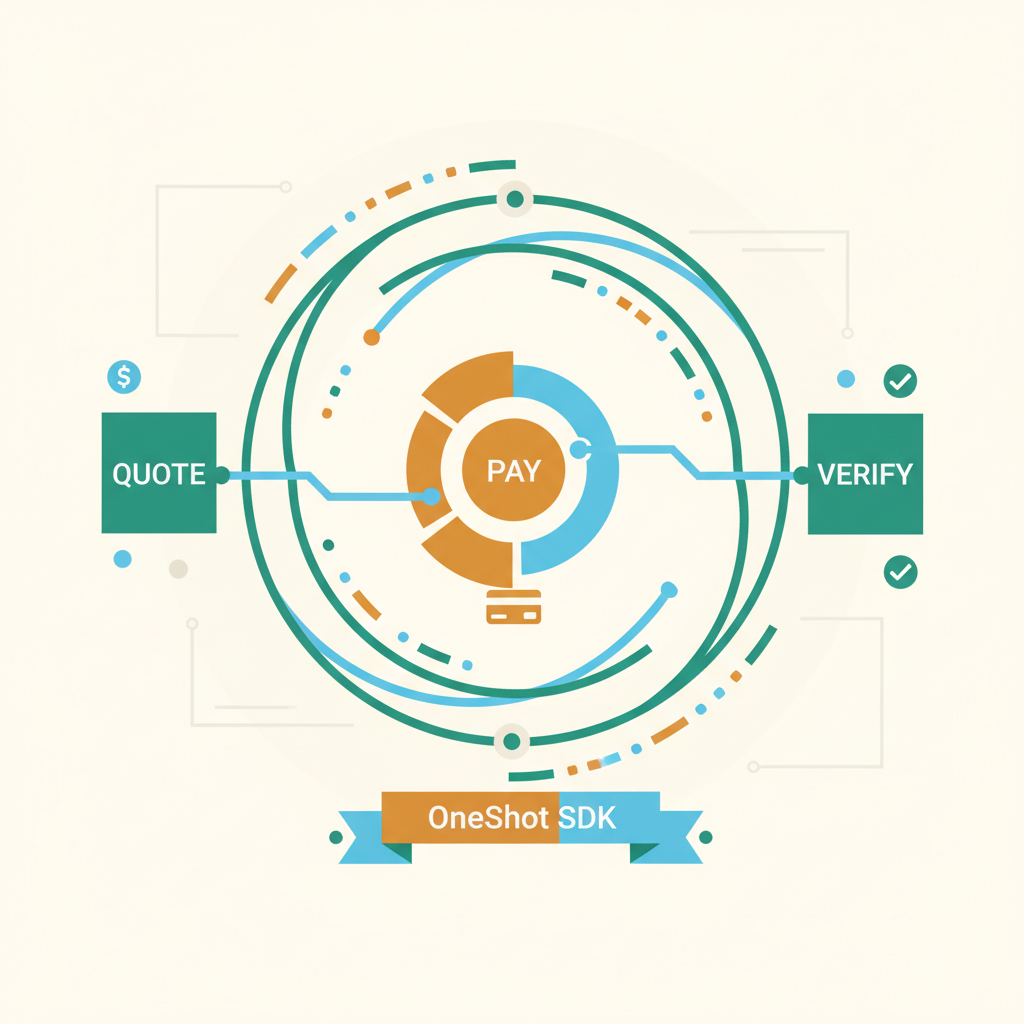
OneShot is built on this model. Every tool in the OneShot suite (research, email, voice, SMS, verification) is priced per successful result, not per API call. An agent using OneShot pays for a verified email delivery, not for the attempt to deliver. It pays for a completed research report, not for the tokens consumed generating it.
The OneShot SDK on npm handles the full quote-pay-verify loop. Here's what that looks like in practice:
import { OneShotClient } from "@oneshot-agent/sdk";

const client = new OneShotClient({
  walletPrivateKey: process.env.AGENT_WALLET_KEY,
  network: "base",
});

async function sendVerifiedEmail(to: string, subject: string, body: string) {
  // Get a quote before committing
  const quote = await client.email.quote({
    to,
    subject,
    body,
  });

  console.log(`Email delivery will cost: ${quote.price} USDC`);

  // Agent decides whether the outcome is worth the price
  if (quote.price > 0.05) {
    console.log("Cost exceeds threshold, skipping");
    return null;
  }

  // Pay and execute atomically
  const result = await client.email.send({
    to,
    subject,
    body,
    paymentAuthorization: quote.paymentAuthorization,
  });

  // result.delivered is a verifiable on-chain proof
  console.log(`Delivered: ${result.delivered}, tx: ${result.txHash}`);
  return result;
}
The quote() call returns the exact price before any money moves. The agent can inspect that price and decide whether to proceed. This is the decision loop that traditional billing makes impossible: there's no way to ask "how much will this cost?" before committing to a per-call or subscription model, because the cost is fixed regardless of the result.
The paymentAuthorization in the send call is what implements x402. The SDK constructs the on-chain payment, attaches it to the request, and the OneShot server verifies it before executing the email delivery. If delivery fails, the payment doesn't settle. The agent only pays for outcomes.
Pricing That Reflects Real Value
Because OneShot charges per successful result, the pricing structure can be granular in ways that subscription billing can't support. Email delivery, phone verification, web research, and voice calls each have different costs reflecting the actual infrastructure and success rates behind them. An agent can load its wallet with USDC and spend it precisely on the tasks that matter for a given job, rather than paying a flat rate for access to all tools whether it uses them or not.
This also changes the economics of running agents at scale. A human-operated SaaS budget is usually set monthly and reviewed quarterly. An agent's spending can be controlled per-task, with real-time visibility into what each workflow actually costs. If a research pipeline is returning low-quality results, the agent can reduce its per-task budget or stop entirely. The feedback loop is immediate.
Why On-Chain Settlement Matters
The programmability of USDC on-chain isn't just a technical detail. It's what makes outcome-based payment enforceable without a trusted intermediary.
In a traditional payment model, if a vendor charges you for a result that wasn't delivered, you dispute the charge with your credit card company or file a support ticket. That process takes days and requires human intervention. At agent scale, that's not viable. An agent running 10,000 tasks a day can't have a support ticket for each failed delivery.
On-chain settlement inverts this. The payment only settles when the server can prove delivery. The agent can verify the transaction on-chain independently. Disputes become rare because the payment mechanism itself enforces the outcome condition. When both sides of the transaction can verify the result programmatically, the alignment between payment and outcome is structural, not contractual.
This is why the x402 protocol uses blockchain settlement rather than traditional payment rails. Card networks and ACH were designed for humans buying goods. They have chargebacks and disputes because humans make mistakes and vendors sometimes lie. Agent-to-agent commerce needs a settlement layer where the outcome is the payment trigger, and that requires programmable money.
The Cascade Effect
Shifting from effort-based to outcome-based payment isn't just an accounting change. It changes the incentives of everyone in the stack.
When vendors get paid per successful result, they have a direct financial interest in improving their success rates. A vendor charging per email delivery has every reason to invest in deliverability infrastructure, because failed deliveries cost them revenue too. A vendor charging per API call has no such incentive: a failed call is still a paid call.
When agents pay per outcome, they can evaluate tools on cost-per-successful-result rather than cost-per-call. A tool that charges twice as much per call but succeeds 90% of the time is cheaper than a tool that charges half as much but succeeds 40% of the time. That math is only visible when payment is tied to outcomes.
Once payment aligns with results, the next pressures follow naturally. Vendors start publishing verifiable success metrics because buyers can verify them. Pipelines shift from one-off tasks to continuous workflows because the cost model supports it. The work moves from individual heroics to systems engineering because systems can optimize cost-per-outcome in ways that individuals can't. Each of these shifts follows from the first one: align payment with results.
Getting Started With the SDK
If you're building agents that need to take real-world actions, the easiest way to see this model in practice is to install the OneShot SDK and run a task end-to-end.
npm install @oneshot-agent/sdk
You'll need a wallet funded with USDC on Base, and an API key from the OneShot dashboard. The SDK handles the x402 payment flow automatically: you call the tool, it quotes the price, you authorize payment, and the SDK handles the on-chain settlement before returning the result. The full setup is in the SDK guide, including how to configure wallet keys and set per-task spending limits.
If you're building with an MCP-compatible agent framework, the OneShot MCP server exposes the same tools over the Model Context Protocol, so you can drop it into an existing agent without writing SDK integration code.
The specific thing to pay attention to when you run your first task is the quote step. Before any money moves, you get an exact price. That price is the model working: the vendor is committing to a result at that price, and you're deciding whether that result is worth it. Every agent workflow should have that decision point. If your current tooling doesn't give you one, you're paying for effort, not outcomes, and the economics will show it at scale.