The 9-Layer Industrial Intelligence Stack: A Blueprint for AI Agent Infrastructure
 J Nicolas
Every industrialized domain builds the same infrastructure in the same order. Electricity needed generation, transmission, switching, metering, and billing before it could power factories. Logistics needed routing, tracking, warehousing, customs, and carrier networks before Amazon could promise next-day delivery. The sequence is not arbitrary: each layer depends on the one below it, and you cannot skip ahead without paying a debt later.
Agent commerce is building those layers right now, in real time, and most of the people building them do not recognize the pattern they are following. This article names the nine layers, explains what each one does, shows where the current infrastructure sits on that stack, and identifies the gaps that will determine who wins the next 18 months.
Why nine layers, and why this order
The SolveEverything framework describes how cognition becomes a commodity through domain collapse. The Industrial Intelligence Stack is its structural output: the nine layers that any domain must build before intelligent automation can operate at utility scale. The order matters because each layer's output is the input to the layer above it. Trying to build Layer 6 without Layer 3 is like wiring a building before the electrical code exists.
The nine layers are: Purpose, Task Taxonomy, Observability, Targeting, Model, Actuation, Verification, Governance, and Distribution. Here is what each one actually means in the context of agent infrastructure.
Layer 1: Purpose
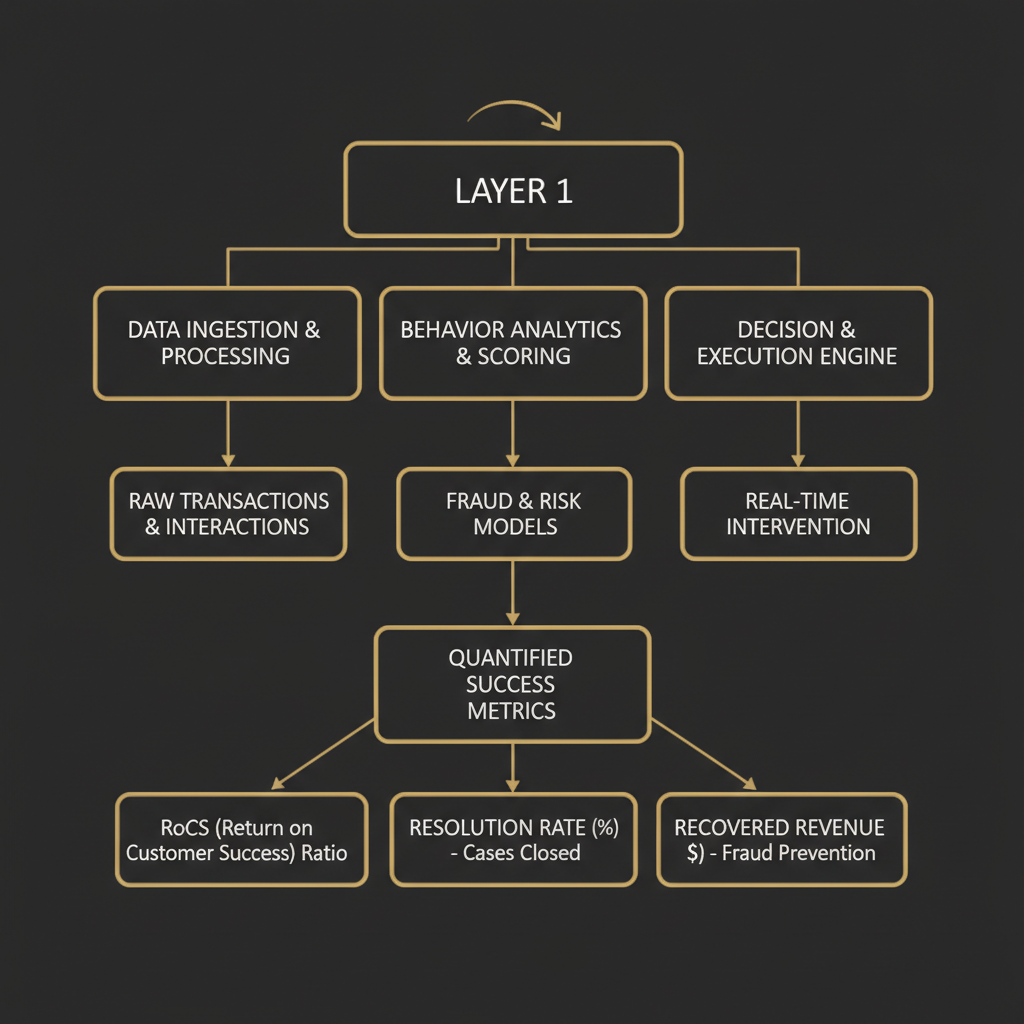
Purpose is not a mission statement. It is a quantified success metric that all participants agree to optimize. Without it, every downstream layer is measuring the wrong thing.
In agent commerce, the Purpose layer is where outcome-based pricing originates. Freebot charges per resolution, not per minute of hold time. Freway charges commission on recovered sales, not per email sent. These are not marketing decisions; they are architectural ones. The metric you charge on becomes the signal the entire system optimizes for.
The specific metrics that have emerged as candidates for standardization are Resolution Rate (percentage of cases where the agent achieves the user's stated goal), Return on Cognitive Spend (RoCS, revenue or cost savings divided by agent spend), and Recovered Revenue Rate (for checkout abandonment specifically, the percentage of at-risk transactions completed). RoCS is the most generalizable because it works across verticals without domain-specific tuning.
Most agent deployments today have not formalized their Purpose layer. They track token spend or API call counts, which are cost metrics, not outcome metrics. This is equivalent to a logistics company tracking truck fuel consumption instead of on-time delivery rate.
Layer 2: Task Taxonomy
Once you have a success metric, you need to decompose agent work into measurable atomic actions. Task Taxonomy is the ontology of what agents do.
For a customer service agent, the taxonomy might look like: classify intent, retrieve account state, identify resolution path, execute resolution action, confirm outcome, escalate if unresolved. Each action has a measurable duration, a success condition, and a cost. Without this decomposition, you cannot identify where failure occurs, which makes improvement impossible.
The practical output of Layer 2 is a directed acyclic graph of agent tasks where each node has defined inputs, outputs, and failure modes. Here is a minimal example of what a task node definition looks like in code:
// Task node definition for a resolution agent
const resolveHoldTask = {
  id: "place_hold_call",
  inputs: {
    phone_number: "string",
    issue_description: "string",
    max_wait_minutes: "number"
  },
  outputs: {
    call_sid: "string",
    hold_duration_seconds: "number",
    agent_reached: "boolean",
    transcript_url: "string"
  },
  success_condition: (output) => output.agent_reached === true,
  cost_model: {
    base_usdc: 0.05,
    per_minute_usdc: 0.02
  },
  timeout_seconds: 3600,
  failure_modes: ["no_answer", "call_dropped", "ivr_loop", "max_wait_exceeded"]
};
This structure makes the task machine-readable, which is the prerequisite for Layer 3.
Layer 3: Observability
Observability is the nervous system of the stack. It is the infrastructure that records what happened, when, at what cost, and with what outcome. Without it, you are flying blind.
In agent systems, observability is harder than in traditional software because agent behavior is nondeterministic. The same input can produce different action sequences depending on model temperature, tool availability, and intermediate state. This means you need to log not just inputs and outputs but the full reasoning trace, including which tools were called, in what order, with what parameters, and what each returned.
A useful observability schema for an agent transaction looks like this:
// Agent transaction log entry
{
  "transaction_id": "txn_7f3a9b2c",
  "agent_id": "freebot_v2.1",
  "session_start": "2025-01-15T14:23:11Z",
  "session_end": "2025-01-15T14:47:33Z",
  "duration_seconds": 1462,
  "purpose_metric": "resolution_rate",
  "outcome": "resolved",
  "tool_calls": [
    {
      "tool": "oneshot.voice.call",
      "timestamp": "2025-01-15T14:23:15Z",
      "latency_ms": 2100,
      "cost_usdc": 0.05,
      "result": "connected"
    },
    {
      "tool": "oneshot.voice.hold_detection",
      "timestamp": "2025-01-15T14:23:18Z",
      "latency_ms": 340,
      "cost_usdc": 0.01,
      "result": "on_hold"
    },
    {
      "tool": "oneshot.sms.send",
      "timestamp": "2025-01-15T14:46:55Z",
      "latency_ms": 890,
      "cost_usdc": 0.008,
      "result": "delivered"
    }
  ],
  "total_tool_cost_usdc": 0.847,
  "resolution_value_usd": 47.00,
  "rocs": 55.5
}
The RoCS figure at the end (47.00 / 0.847 = 55.5) is what Layer 1 defined as the success metric. Observability closes the loop between what the agent did and whether it worked.
Layer 4: Targeting
Targeting is the layer that drives improvement. It is public benchmarks, leaderboards, and standardized evaluation sets that let agents compete on measurable outcomes. This is the layer that is almost entirely missing from agent infrastructure today.
In every other industrialized domain, the Targeting layer is what created competitive markets. SPEC benchmarks for CPUs. PageRank for web search quality. Kaggle leaderboards for ML models. The benchmark does not just measure performance; it defines what performance means, which concentrates competitive energy on the right problems.
For agent commerce, the Targeting layer needs standardized test suites: a corpus of customer service scenarios with known ground-truth resolutions, a set of checkout abandonment cases with known recovery rates, a benchmark for research agent accuracy on verifiable factual questions. Without these, agents cannot be compared objectively, which means buyers cannot make informed purchasing decisions, which means the market cannot clear efficiently.
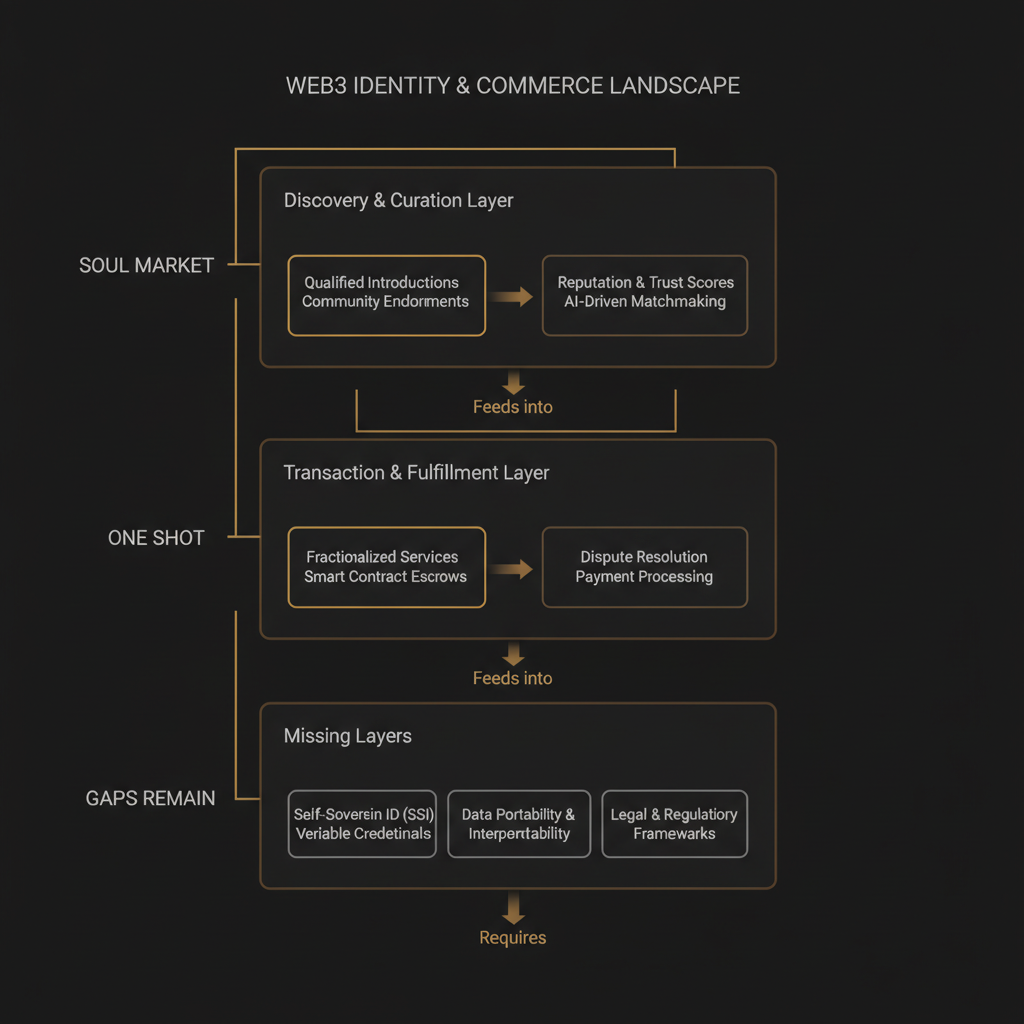
This is the layer that Soul.Markets is positioned to build. A marketplace of agent identities (soul.md files) without a standardized evaluation layer is just a directory. With it, it becomes the scoreboard for agent commerce.
Layer 5: Model
The Model layer is the agent itself: the LLM, the reasoning engine, the prompt architecture, and the identity definition. This is the layer that gets the most attention and is arguably the least differentiating over a 3-year horizon, because model capability is commoditizing faster than any other layer.
The soul.md format is a structured identity file for an agent that defines its purpose, capabilities, constraints, and pricing. It sits at Layer 5 because it is the specification that the Model layer executes. An agent without a soul.md is like a contractor without a scope of work: technically capable but commercially undefined.
The key insight about Layer 5 is that the model is not the moat. The moat is the combination of a well-specified purpose (Layer 1), a rich task taxonomy (Layer 2), and dense observability data (Layer 3) that lets you fine-tune and evaluate the model against real outcomes. GPT-4o and Claude Sonnet are roughly interchangeable for most agent tasks today. What is not interchangeable is the training signal that comes from 100,000 logged resolution attempts with verified outcomes.
Layer 6: Actuation
Actuation is where agents touch the real world. API calls, phone calls, emails, SMS messages, payments, form submissions. This is the layer that OneShot covers directly.
The critical property of a good actuation layer is that it is atomic and auditable. Each action either succeeded or failed, and that fact is recorded and verifiable. This is why the x402 protocol matters: it makes payment an atomic operation that settles on-chain, which means the actuation event and the payment event are the same event. There is no reconciliation step, no invoice dispute, no net-30 payment terms.
Current OneShot actuation primitives and their approximate costs and latencies (based on observed performance, estimates where marked):
- Voice call initiation: ~2,100ms latency, $0.05 base + $0.02/minute
- Email send: ~800ms latency, $0.008 per message
- SMS send: ~890ms latency, $0.008 per message
- Web research query: ~3,400ms latency, $0.02 per query (estimate)
- Identity verification: ~1,200ms latency, $0.05 per check (estimate)
The OneShot SDK wraps these primitives in a TypeScript interface that handles authentication, payment, retry logic, and error normalization. Here is what calling a voice tool looks like in practice:
import { OneShotClient } from "@oneshot-agent/sdk";

const client = new OneShotClient({
  apiKey: process.env.ONESHOT_API_KEY,
  walletPrivateKey: process.env.AGENT_WALLET_KEY, // pays via x402
});

async function escalateToHuman(
  phoneNumber: string,
  context: string,
  maxHoldMinutes: number
): Promise {
  const call = await client.voice.call({
    to: phoneNumber,
    instructions: `You are resolving the following issue: ${context}.
      Wait on hold up to ${maxHoldMinutes} minutes.
      When a human answers, explain the issue clearly and request a specific resolution.
      Do not accept vague promises. Confirm a case number or reference ID.`,
    webhookUrl: "https://your-agent.com/webhooks/call-complete",
    maxDurationMinutes: maxHoldMinutes + 5,
  });

  // Poll for completion (or use webhook)
  const result = await client.voice.waitForCompletion(call.callSid, {
    timeoutMs: (maxHoldMinutes + 5) * 60 * 1000,
    pollIntervalMs: 5000,
  });

  return {
    resolved: result.agentReached && result.outcomeConfirmed,
    referenceId: result.extractedData?.referenceId,
    transcriptUrl: result.transcriptUrl,
    durationSeconds: result.durationSeconds,
    costUsdc: result.billedUsdc,
  };
}
The payment happens inside client.voice.call(). The agent's wallet signs an x402 payment claim before the call is initiated. If the wallet has insufficient balance, the call fails before any phone infrastructure is touched.
Layer 7: Verification
Verification is the quality assurance layer: adversarial testing, red-teaming, output validation, and fraud detection. It answers the question "did the agent actually do what it claimed to do?"
This layer is where agent commerce differs most sharply from traditional software QA. The failure modes are not crashes or error codes; they are subtle behavioral failures. An agent that reports a resolution but did not actually confirm a case number. An agent that sends an email but addresses it to the wrong party. An agent that claims to have waited on hold for 20 minutes but actually disconnected after 2.
Verification requires a combination of automated checks against the observability record (Layer 3) and periodic human review of sampled transcripts. The automated checks are straightforward: does the transcript URL resolve? Does the extracted reference ID match the format the company uses? Did the call duration match the billed duration?
The harder problem is detecting adversarial behavior from the companies agents interact with. A telecom company that routes agent calls to a dead queue. A retailer that issues refund confirmations that expire before processing. These are Layer 7 problems that require building a corpus of known adversarial patterns, which feeds back into Layer 4 (Targeting) as test cases.
Layer 8: Governance
Governance is the incentive structure that aligns all participants. Pay-for-outcomes is the governance primitive for agent commerce, and it is doing more structural work than it appears to.
When Freebot charges only on resolved cases, the incentive structure forces the agent to be selective about which cases it takes, to invest in verification (Layer 7) to confirm resolution, and to build observability (Layer 3) to identify which case types have high resolution rates. The outcome-based payment model is not just a pricing strategy; it is a governance mechanism that self-enforces quality.
The x402 protocol makes governance programmable. A smart contract can hold payment in escrow, release it when the verification oracle confirms resolution, and return it to the user if the agent fails. This turns governance from a legal agreement into a cryptographic protocol. The current infrastructure supports simple escrow; conditional multi-party escrow with verification oracle integration is the next step.
Layer 9: Distribution
Distribution is utility-scale deployment: the infrastructure that gets agents in front of end users at scale without requiring each user to configure, authenticate, and fund an agent individually.
This is the layer that is furthest from maturity in agent commerce. Freebot and Freway solve distribution for their specific verticals (consumer customer service and checkout respectively), but general-purpose agent distribution infrastructure does not yet exist. The closest analogs are app stores and API marketplaces, but neither model fits well because agents are stateful, long-running, and outcome-dependent in ways that apps and APIs are not.
The Soul.Markets marketplace is an early attempt at solving Layer 9 alongside Layer 4. Listing an agent's soul.md file makes it discoverable and commercially available, but the distribution problem also requires identity portability (an agent that works in one context should be able to operate in another without reconfiguration), payment routing at scale, and reputation systems that persist across deployments.