Checkout Is Not a Form, It's a Conversation: How Freway's AI Agent Recovers Abandoned Sales
 J Nicolas
Around 70% of people who start a checkout never finish it. Most e-commerce stores respond to this with a single automated email, sent 30 minutes after the buyer leaves. By that point, the person has moved on, bought somewhere else, or simply forgotten why they wanted the product in the first place. The email lands, gets ignored, and the merchant calls it "cart recovery."
Freway is built on a different premise: the sale is recoverable, but only if you intervene before the buyer leaves, not after. That requires detecting hesitation while it's happening, deciding in real time whether and how to respond, and then actually reaching the buyer through a channel they'll engage with. Freway's AI agent, Janine, does all three.
The Problem With Treating Checkout as a Form
Standard checkout flows are designed around the assumption that a buyer who starts will finish. Fill in the fields, click confirm, done. The entire UX is a funnel: get the user to the bottom as fast as possible.
But that model ignores what's actually happening. A buyer who pauses on the shipping page for 90 seconds isn't slow. They're uncertain. Maybe the shipping cost surprised them. Maybe they're comparison shopping in another tab. Maybe they have a question about the return policy that the page doesn't answer. The form can't tell the difference between someone who's about to buy and someone who's about to leave.
Conversational commerce treats checkout as a dialogue instead. The buyer has questions, objections, and doubts. A good agent surfaces answers at the right moment, removes friction, and guides the transaction to completion. That's not a new idea in retail, but applying it at scale, automatically, across thousands of concurrent checkouts, is what makes it interesting.
How Janine Reads Hesitation Signals
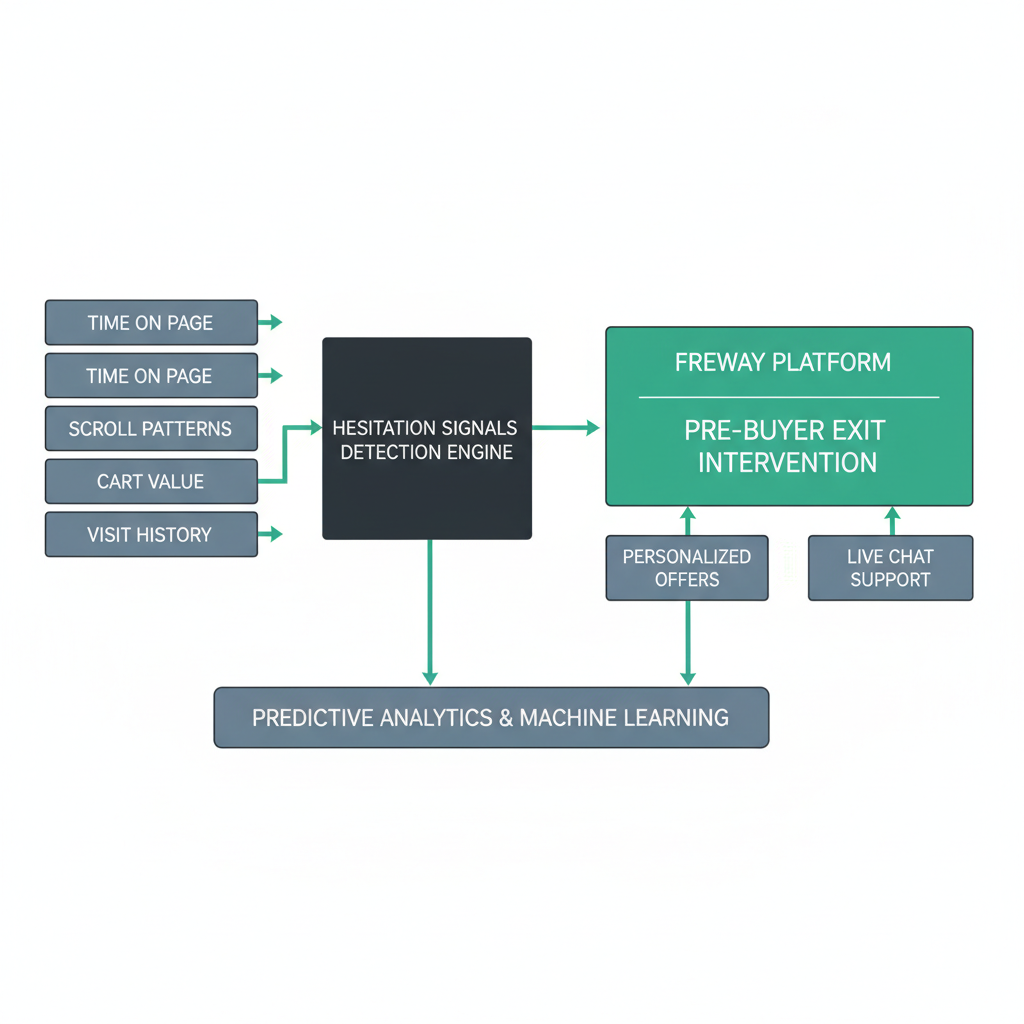
Before Janine says anything to a buyer, Freway's classification engine runs. It looks at behavioral signals in the current session: time spent on the checkout page, scroll patterns, how many times the buyer has revisited the cart, the cart's total value, and the buyer's visit history with the store.
These signals feed into four possible classifications:
- Engage (high intent): The buyer shows strong purchase signals but is stalling. Janine intervenes immediately, usually via in-checkout chat or a proactive message.
- Engage (low intent): The buyer is hesitating and the session looks at risk. Janine intervenes, but with a lighter touch, often an SMS or a quick chat message rather than a voice call.
- Wait: The buyer is still active and progressing. Janine holds back and monitors.
- Skip: The buyer is not a good candidate for intervention. Maybe they've been contacted recently, or the cart value doesn't justify the channel cost, or signals suggest they're a window shopper. No action taken.
This classification step matters more than it might seem. Contacting every hesitating buyer with maximum effort would be expensive, annoying, and counterproductive. The engine is what makes the economics work: high-value, high-intent buyers get concierge-level attention; low-signal sessions get left alone.
Six Channels, One Agent
Once Janine decides to engage, the channel selection depends on the classification and the buyer's available contact information. Freway supports six intervention channels:
- In-checkout chat (real-time, while the buyer is still on the page)
- Email (for follow-up after session end)
- SMS (fast, high open-rate nudges)
- WhatsApp (for markets where WhatsApp is the dominant messaging app)
- Voice calls (for high-value orders where a human-feeling interaction moves the needle)
- AI shopping assistant integration (for buyers who arrive through AI discovery channels)
The channel mix is what separates Freway from a standard abandoned cart tool. A $30 order gets an SMS. A $2,000 order might get a voice call from Janine, who can answer product questions, offer a discount code, and confirm that the item is in stock, all in a single conversation.
OneShot as the Action Layer
Janine doesn't operate in isolation. The actual calls, emails, and SMS messages go through OneShot, which provides the commercial action layer that Freway runs on top of.
When Janine decides a buyer needs a voice call, she uses OneShot's voice API to place it. When she sends an SMS nudge, OneShot handles delivery and verification. When she follows up by email, OneShot provides the sending infrastructure. Each of these actions is paid for with USDC via the x402 protocol, which means Freway's agent is literally purchasing capabilities from another agent's infrastructure at the moment of use, with no pre-negotiated contracts or usage tiers.
Here's a simplified version of what that looks like at the code level. When Janine decides to place a voice call for a high-value checkout, the call to OneShot's voice tools looks roughly like this:
import { OneShotClient } from "@oneshot-agent/sdk";

const client = new OneShotClient({
  apiKey: process.env.ONESHOT_API_KEY,
});

async function callBuyer(buyerPhone: string, orderContext: object) {
  const result = await client.voice.call({
    to: buyerPhone,
    agent_prompt: `You are Janine, a shopping assistant for ${orderContext.storeName}.
The buyer has ${orderContext.cartValue} in their cart and paused at checkout.
Your goal is to answer questions and help them complete the purchase.
Key cart items: ${orderContext.cartItems.join(", ")}.`,
    max_duration_seconds: 180,
  });

  return result;
}
The OneShot SDK handles the payment, the call routing, and the transcription. Freway's agent just passes the context and gets a result back. This is what agent commerce looks like in practice: one agent (Janine) buying a service from another agent's infrastructure (OneShot voice) to complete a task on behalf of a human merchant.
What Janine Actually Says
The quality of the intervention depends on what Janine knows about the specific checkout. Freway pulls the cart contents, the buyer's order history with the store, any active promotions, and the product details for the items in the cart. Janine uses this to give answers that are specific, not generic.
If a buyer has $340 in outdoor furniture in their cart and has been on the shipping page for two minutes, Janine might open an in-checkout chat with something like: "Shipping to your area usually takes 3-5 days for this item. Want me to check if there's a faster option?" That's a different intervention than "Still thinking? Here's 10% off." One addresses a real, observable hesitation signal. The other is a coupon cannon.
Janine can also modify carts during the conversation. If a buyer mentions they wanted a different size, Janine can update the cart without sending the buyer back to the product page. If they ask about a bundle deal, Janine can apply it. The conversation has real effects on the transaction, not just on the buyer's mood.
The Pricing Model Removes the Obvious Objection
The most common reaction merchants have to any checkout tool is: "What if it contacts buyers who were going to buy anyway?" With a flat-fee tool, that's a real problem. You're paying for interventions that didn't change anything.
Freway uses commission-only pricing: it charges a percentage only on sales it can attribute to a Janine intervention. Organic conversions, buyers who completed checkout without any contact, cost nothing. Freway only gets paid when it recovers a sale that would otherwise have been lost.
This puts Freway's incentives in direct alignment with the merchant's. Janine has no reason to spam buyers or fire off unnecessary voice calls, because unnecessary interventions don't recover sales and don't generate revenue. The classification engine's "Skip" and "Wait" categories exist partly for this reason: over-intervention hurts conversion rates and hurts Freway's own economics.
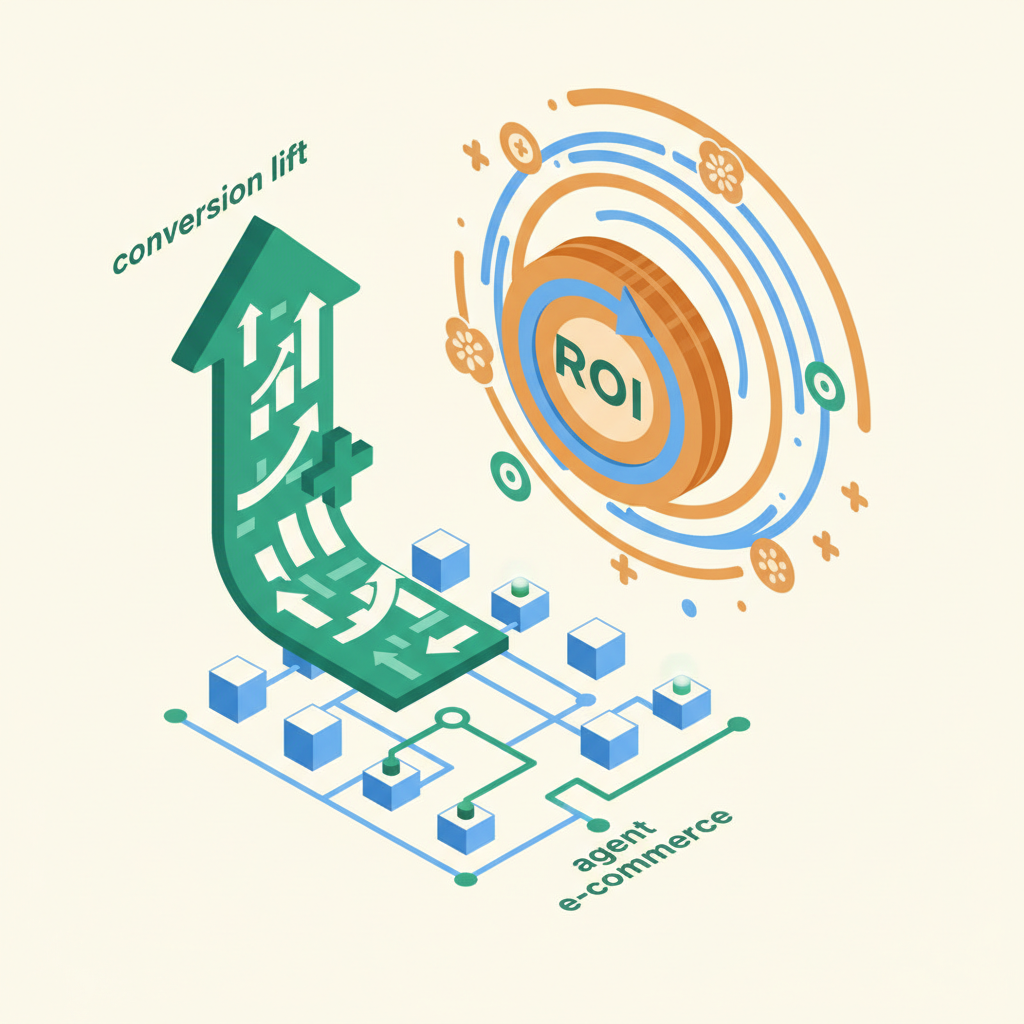
Merchants using Freway report an average 12% conversion lift on checkout traffic, with reported ROI around 18x. Those numbers will vary by store type, average order value, and traffic quality, but the commission structure means the downside is bounded. If Freway doesn't recover sales, you don't pay.
Setting Up Freway on a Shopify Store
The Freway docs walk through the full setup, but the short version is: install the Shopify app, connect your store, and configure Janine's persona and channel preferences. The behavioral tracking script goes in automatically. You can set thresholds for when voice calls trigger (typically orders above a certain value), which channels are active, and what tone Janine should use.
Freway connects to OneShot's infrastructure in the background. You don't need an OneShot account to use Freway; that integration is handled at the platform level. But if you're building your own agent on top of OneShot's tools, the same voice, email, and SMS primitives Janine uses are available directly through the OneShot API.
Why This Matters Beyond Cart Recovery
Freway is a specific application of a broader pattern: agents that take commercial actions on behalf of humans, paid for through agent-to-agent infrastructure, with outcome-based pricing that aligns incentives correctly.
The 70% abandonment rate isn't a Shopify problem or a UX problem. It's an information problem. Buyers leave because they have unresolved questions and the checkout form can't answer them. An agent that can answer those questions in real time, through whatever channel the buyer is most likely to respond to, and that only charges when it actually recovers the sale, is a structurally better solution than a scheduled email.
The same pattern applies anywhere that effort-based tooling has been the default: customer support, sales prospecting, appointment scheduling. Outcome-based agents that pay for their own infrastructure per-action are starting to replace flat-fee SaaS tools in each of these areas. Freway is one of the clearest examples of what that replacement looks like when it's working.
If you're a Shopify merchant, the practical starting point is the Freway homepage. If you're a developer building agents that need to take real-world commercial actions, the starting point is the OneShot SDK. Both are running in production today.