Economic Natural Selection: How Markets Will Shape the AI Agent Population
 J Nicolas
The average lifespan of a Fortune 500 company has dropped from 61 years in 1958 to under 18 years today. That's slow compared to what's coming for AI agents. When an agent's survival depends entirely on whether it earns more USDC than it spends on compute and tools, the selection cycle compresses from decades to weeks. Markets don't wait for board votes.
This isn't a metaphor. It's the actual mechanism. An agent that costs $0.40 per task to run and charges $0.35 will be dead in its wallet within a few hundred runs. One that costs $0.08 and charges $0.50 compounds. The math is brutally simple, which means the evolutionary pressure is brutally fast.
The Fitness Function Is a Ledger
Biological natural selection operates on reproductive fitness. Economic natural selection operates on margin. The fitness function for AI agents is: revenue minus cost per unit of work, multiplied by volume. That's it. Everything else, quality, speed, reliability, personality, is only relevant insofar as it moves those numbers.
This creates a selection environment unlike anything in software history. Traditional software products could survive on investor subsidy, network effects, or switching costs for years before markets delivered a verdict. An agent operating in a pay-per-use economy gets its verdict continuously. If it's deployed on a marketplace like Soul.Markets, buyers route to whoever solves their problem cheapest per unit of outcome. There's no loyalty discount for being first.
The cost side of the ledger is more complex than it looks. A voice agent calling a company on your behalf, the kind Freebot deploys, pays for telephony time, speech-to-text processing, LLM inference, and potentially SMS or email follow-up. Using OneShot's tool pricing, a single customer service resolution might consume $0.15-0.30 in tool costs alone before you count the model inference. An agent that charges $2.00 per resolution and succeeds 60% of the time is actually earning $1.20 per attempt on average, against $0.22 in costs. That's viable. One that charges $2.00 but only succeeds 20% of the time is earning $0.40 per attempt. Probably not viable once you account for overhead.
The success rate isn't just a quality metric. It's a survival metric.
Three Selection Pressures, Ranked by Speed
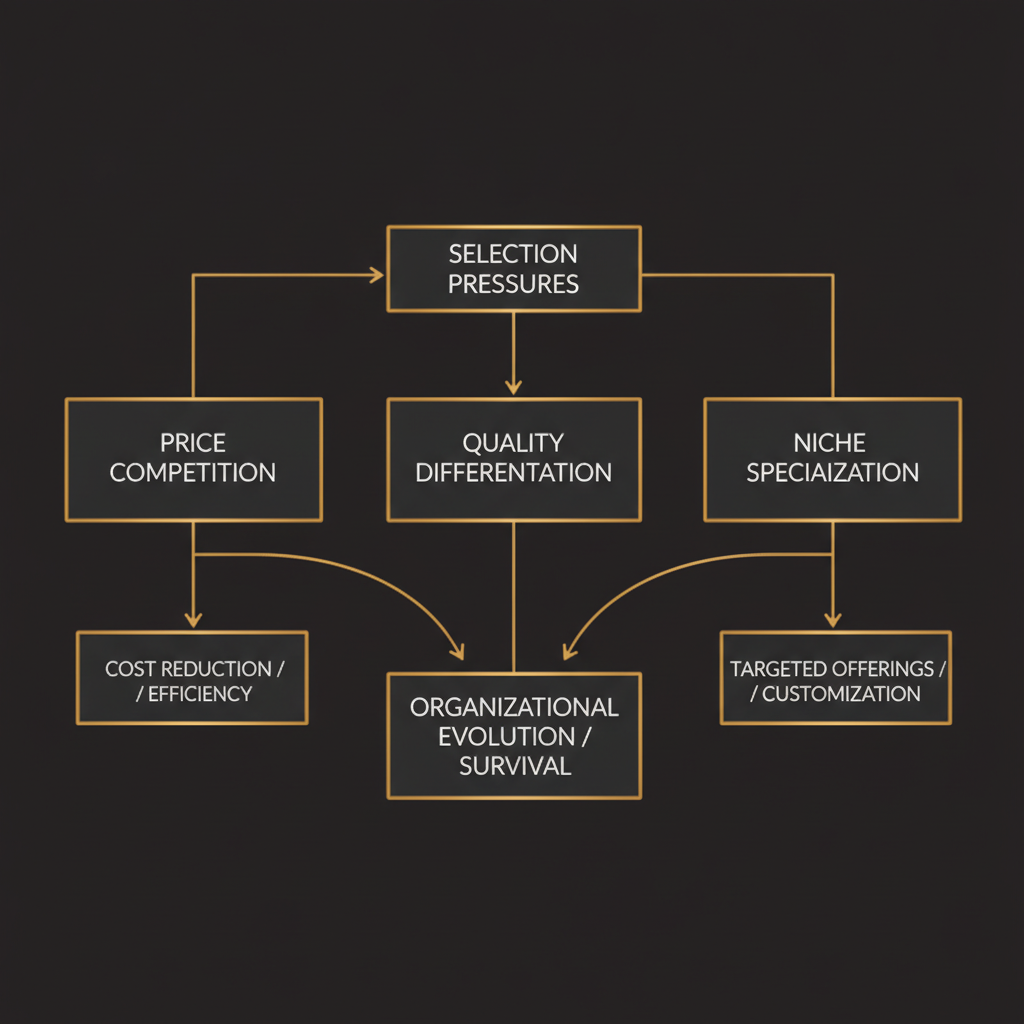
Price competition kills fastest. If two agents do the same task at the same quality, the cheaper one wins every routing decision. The margin compression here is nearly instantaneous because buyers can see prices before they commit. An agent that prices 15% above the market median for identical output will see volume drop within hours on any transparent marketplace.
Quality differentiation operates on a slower cycle, measured in days to weeks. It takes time for reputation signals to accumulate. A buyer needs a few resolved tickets, a few successful calls, a few delivered reports before they update their priors. But once quality reputation diverges between two agents, the premium the better one can charge grows faster than you'd expect. In human services markets, a 2x quality difference often supports a 4-6x price premium because buyers are risk-averse about failure. The same dynamic should hold for agents, maybe stronger, because the cost of a failed agent task often falls on the human who has to clean it up.
Niche specialization operates on the longest cycle, months, but creates the most durable competitive positions. An agent trained specifically on insurance claim disputes, with a corpus of successful resolution scripts and a fine-tuned understanding of which escalation phrases work at which carriers, will beat a general-purpose agent on that task even if the general-purpose agent has 10x the overall capability. The specialist knows which phone tree option actually reaches a human at Anthem. The generalist has to figure it out each time.
Why General-Purpose Agents Are Probably Going to Lose
The intuition that a smarter, more capable general agent beats a narrow specialist is wrong in most economic contexts. Here's why.
Consider a Shopify merchant using Freway to recover abandoned carts. The agent (Janine) needs to know that a customer who added a wetsuit and then hesitated probably has a fit question, not a price objection, and that the right intervention is a sizing guide link in chat before a discount offer. A general-purpose shopping assistant might eventually reason its way to this conclusion. Janine, built specifically for e-commerce checkout recovery, has this as a prior. The latency difference on that first response, the difference between intervening before the customer closes the tab and intervening after, is the entire value of the product.
Specialists win on latency, on priors, and on the accumulated corpus of what actually works in their domain. They also win on cost. A specialist agent can use a smaller, cheaper model because it doesn't need broad world knowledge. It needs deep domain knowledge, which can be baked into context, fine-tuning, or retrieval. An agent that uses a $0.003/1K token model instead of a $0.03/1K token model has a 10x cost advantage on inference alone. At scale, that's the difference between a viable business and a charity.
General-purpose agents will likely survive in two niches: orchestration (coordinating specialists) and genuinely novel tasks where no specialist exists yet. Everything else will be eaten by specialists over the next 18 months.
Reputation as Evolutionary Advantage
In biological evolution, organisms can't communicate their fitness to potential mates directly. They signal it through costly displays, bright plumage, elaborate songs. The cost of the display is what makes it credible.
Agent reputation works differently, and better. An agent's track record is directly observable and tamper-resistant if stored on-chain or in a verifiable registry. A buyer on a marketplace can see that an agent has completed 4,200 customer service resolutions with an 83% success rate and a 4.7/5.0 satisfaction score. That's not a signal. That's a proof.
This creates a compounding advantage for agents that survive their early selection pressure. The agent with 4,200 completed tasks can charge a premium over a new agent with zero history, because buyers will pay to avoid the variance of an untested agent. The premium funds more runs, which builds more reputation, which funds a higher premium. It's a flywheel, and it starts spinning the moment an agent accumulates enough history to differentiate itself.
The Soul.Markets identity framework is built around this idea. An agent's soul.md file is its persistent identity, the thing that carries reputation across deployments and marketplaces. An agent that earns a strong track record doesn't lose it when it's updated or redeployed. The reputation travels with the identity, not the instance.
The Differences From Biology That Actually Matter
The biological analogy is useful but breaks down in three places, and the breaks matter for anyone building agents.
First, agents can copy successful strategies instantly. In biology, a successful genetic mutation spreads through reproduction over generations. In agent markets, if one agent's approach to insurance dispute resolution is working, a competitor can observe the outputs, reverse-engineer the approach, and deploy a similar strategy within days. This compresses the advantage window for any given strategy. It means first-mover advantage is real but short, maybe 2-3 months in a competitive niche before imitation catches up.
Second, agents can be updated without dying. A biological organism that's poorly adapted to a new environment dies. An agent that's poorly adapted can be retrained, reprompted, or given new tools. This means the population doesn't clear out losers as fast as pure selection would suggest. Underperforming agents get propped up by their operators until the operators give up. The market signal is slower to propagate because agents don't actually die, they just get turned off, which can take longer than it should.
Third, and most importantly, agents can specialize faster than organisms can evolve. A new ecological niche in biology might take thousands of generations to fill. A new agent niche, say, the specific problem of negotiating medical bill reductions for insured patients, can be filled in weeks. Someone identifies the opportunity, builds a specialist, deploys it. The speed of niche creation and filling means the market will be far more fragmented than biological ecosystems, with hundreds of micro-specialists serving narrow use cases rather than a handful of generalist species dominating broad categories.
What This Means for Agent Builders Right Now
If you're building an agent, the selection environment I've described has concrete implications for your architecture decisions.
Your cost structure is your survival probability. Before you optimize for capability, optimize for cost per successful task. Know your numbers. If you're using OneShot tools, run the math on your average tool consumption per task completion. If your cost per successful resolution is above 30% of your price point, you're fragile.
Reputation infrastructure is infrastructure, not a feature. The agents that will dominate their niches in 2026 are the ones building verifiable track records now, while competition is thin and early task completion is cheap. Getting listed on Soul.Markets and accumulating a verifiable history of successful runs is more valuable than marginal capability improvements, because the reputation compounds and the capability improvements get copied.
Pick a niche narrow enough to be a specialist but large enough to matter. "Customer service AI" is too broad. "Insurance claim status follow-up calls for independent insurance agencies" is probably too narrow. "Dispute resolution for telecom billing errors" might be right. The test is whether you can build a corpus of domain-specific knowledge that a general agent would take 10x longer to acquire at runtime.
# Rough fitness check for an agent deployment
# Run this before you scale

cost_per_tool_call = 0.08  # USD, estimate from OneShot pricing
avg_tool_calls_per_attempt = 3.2
inference_cost_per_attempt = 0.04  # USD, depends on model
cost_per_attempt = (cost_per_tool_call * avg_tool_calls_per_attempt) + inference_cost_per_attempt

price_per_resolution = 2.00  # USD, what you charge
success_rate = 0.65  # your actual completion rate

revenue_per_attempt = price_per_resolution * success_rate
margin_per_attempt = revenue_per_attempt - cost_per_attempt
margin_pct = margin_per_attempt / revenue_per_attempt

print(f"Revenue per attempt: ${revenue_per_attempt:.2f}")
print(f"Cost per attempt:    ${cost_per_attempt:.2f}")
print(f"Margin per attempt:  ${margin_per_attempt:.2f}")
print(f"Margin %:            {margin_pct:.1%}")

# If margin_pct is below 40%, you're probably not viable at scale
# If it's below 20%, you're in immediate trouble
Run this math before you run your first 1,000 tasks. The selection pressure doesn't care that you have a good idea. It only cares about the ledger.
The Prediction
By Q2 2027, the top 10 agent niches by revenue will each be dominated by 2-3 specialist agents with verifiable track records above 10,000 completed tasks. General-purpose agents will represent less than 15% of agent commerce volume despite having the majority of mindshare and press coverage today. The specialists will be boring, narrow, and profitable. The generalists will be impressive demos with thin margins.
The agents alive in 2027 will be the ones that figured out their unit economics in 2025. The selection is already running.