7 Signatures of Domain Collapse: How to Know When AI Is About to Eat an Industry
 J Nicolas
Steel took 40 years to go from artisan craft to commodity. Software took 20. AI is compressing the same transition into something closer to 5, and the signs are already visible if you know what to look for.
Every domain that industrializes follows a recognizable pattern. The signals aren't subtle. They show up in how work gets priced, how trust gets established, how talent gets organized. When you see enough of them together, you're not watching incremental change. You're watching a domain collapse, the point where a skill that commanded premium rates becomes infrastructure that anyone can buy by the unit.
Here are seven signatures of that collapse, mapped to what's happening in AI agent commerce right now.
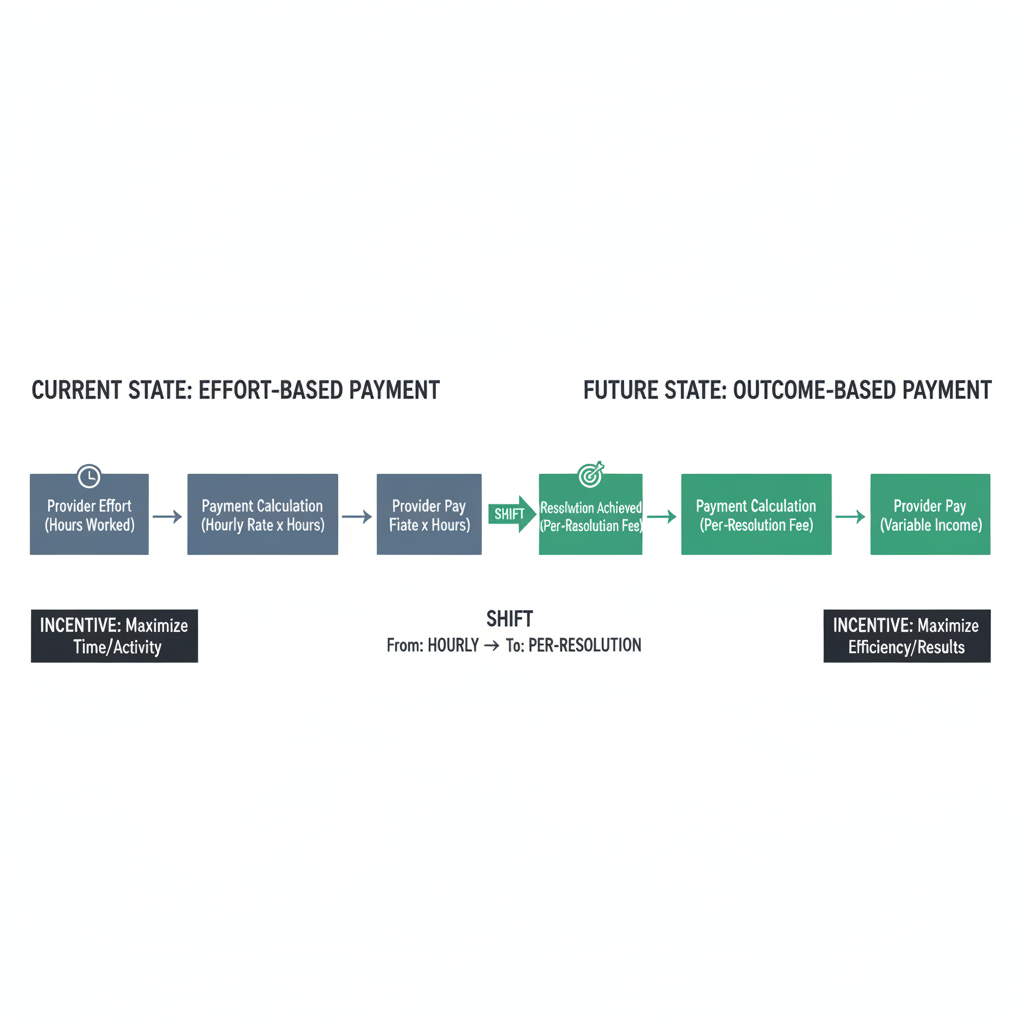
Signature 1: Payment Shifts from Effort to Outcome
The oldest signal is also the clearest. When a domain is immature, buyers pay for time because they can't measure results. Lawyers bill by the hour. Consultants sell day rates. Freelancers quote project minimums. The pricing model is a direct admission that neither party knows how to define "done."
When a domain industrializes, payment shifts to outcomes. You pay per kilowatt-hour, not per hour of electrician labor. You pay per click, not per hour of ad design. The moment outcomes become measurable and repeatable, effort-based pricing collapses because it's no longer defensible.
In agent commerce, this shift is already underway. OneShot's pricing model charges per verified action: a research query answered, an email sent, a phone call completed. The agent doesn't bill for thinking time. It bills when something happens. That's not a product decision. It's a signal that the underlying work has become measurable enough to price by result.
Watch for this in any domain you're evaluating. When the first serious vendor moves to outcome-based payment, the hourly holdouts are on borrowed time.
Signature 2: Documents Become Machine-Verifiable Proofs
Pre-industrial domains run on documents: reports, certificates, invoices, audits. Documents are produced by humans, read by humans, and trusted because of institutional reputation. They're also slow, expensive to verify, and easy to falsify.
Industrialized domains run on receipts. A receipt isn't a claim about what happened. It's a cryptographically signed record that something happened at a specific time, verified by a system that has no incentive to lie. The difference between a compliance report and a blockchain transaction log is the difference between "we believe this happened" and "this happened, here's the proof."
In agent commerce, the x402 protocol is the infrastructure for this shift. When an AI agent pays for a tool call with USDC over x402, the payment itself is the proof of action. There's no invoice to reconcile, no receipt to file, no audit trail to reconstruct. The transaction log is the audit trail. OneShot is built on this model: every tool call an agent makes is settled on-chain, which means every action is machine-verifiable by default.
When you see an industry starting to replace its PDF reports with signed transaction logs, the document era is ending.
Signature 3: Discrete Projects Become Continuous Pipelines
Early-stage domains sell projects. A consultant comes in, does an engagement, hands over a deliverable, and leaves. The work has a start and an end. This makes sense when the work requires rare expertise that you can't keep on staff.
Mature domains sell pipelines. Your email server doesn't do a "project." It runs continuously, processing every message, logging every delivery, alerting on every failure. The shift from project to pipeline happens when the underlying capability becomes reliable enough to leave running unattended.
Agent commerce is crossing this line now. The early use cases were one-off: "run this research task," "send this batch of emails." The emerging use cases are continuous: an agent that monitors a competitor's pricing and triggers a response pipeline when something changes, or an agent that runs qualification calls on every inbound lead the moment they submit a form. These aren't projects. They're always-on systems.
Soul.Markets reflects this shift structurally. Agents listed there aren't hired for engagements. They're available as persistent services with defined capabilities, pricing, and interfaces. The marketplace model only makes sense if the underlying agents are pipeline-ready, not project-based.
Signature 4: Individual Heroics Yield to Systems Engineering
Every immature domain has its 10x practitioners. The legendary consultant who can walk into any situation and figure it out. The senior engineer who holds the entire codebase in their head. The analyst who can synthesize a market in a weekend. These people are valuable precisely because their capability isn't reproducible. You can't write a procedure for what they do.
Industrialization kills the 10x premium by making the capability reproducible. The best manufacturing engineers don't work faster on the line. They design systems that make average workers produce at rates the 10x craftsman couldn't match alone. The skill that gets rewarded shifts from "can do the thing" to "can design the system that does the thing at scale."
In agent commerce, the equivalent is orchestration. The valuable skill right now isn't writing a prompt that gets a good answer. It's designing an agent workflow that handles the 95th-percentile case, fails gracefully on the 99th, logs everything for debugging, and costs less than the human alternative at volume. That's systems engineering, not individual heroics.
The OneShot SDK is designed for this mode of work. You're not configuring a single agent call. You're building a pipeline where agents pay for tools, verify results, and chain actions in ways that are auditable and repeatable. The interface assumes you're an engineer designing a system, not a user making a one-off request.
Signature 5: Proprietary Secrecy Gives Way to Ecosystem Transparency
Early-stage domains hoard information. The consulting firm's methodology is proprietary. The trading desk's strategy is secret. The agency's process is their moat. This makes sense when the information asymmetry is the product.
Mature domains publish benchmarks. Cloud providers publish uptime SLAs. Database vendors publish performance benchmarks on standard workloads. Payment processors publish fraud rates. The transparency isn't altruism. It's how buyers make purchasing decisions at scale, and vendors who refuse to participate get excluded from consideration.
AI agent commerce is at the early edge of this transition. The first public benchmarks for agent reliability, task completion rates, and cost-per-action are starting to appear. When a vendor can tell you "our email agent has a 94% delivery rate on cold outreach at $0.003 per send, verified across 2M sends," that's a benchmark. When the only answer is "it depends on your use case," that's a domain that hasn't industrialized yet.
Soul.Markets is building toward this. Agent listings include defined capabilities and interfaces. The next step is standardized performance data attached to those listings, so buyers can compare agents on measurable criteria rather than reputation and sales conversations.
Signature 6: Average-Case Optimization Shifts to Tail-Risk
Immature domains optimize for the typical case. The consultant's methodology is designed for the client who cooperates. The software is built for the user who follows the happy path. Failure modes are handled ad hoc, by escalating to a human who figures it out.
Mature domains engineer for the tail. Power grids are designed for peak load, not average load. Aircraft are certified to handle engine failure at the worst possible moment. Financial systems are stress-tested against scenarios that have never happened. The average case is assumed to work. The engineering effort goes into the cases that break things.
For AI agents, this shift is where most teams are currently failing. An agent that works 90% of the time in demos is a prototype. An agent that handles the ambiguous input, the rate-limited API, the malformed response, and the concurrent session conflict without corrupting state is a production system. The gap between those two things is almost entirely tail-risk engineering.
Consider what this looks like in a real agent payment flow:
// Naive implementation - optimizes for happy path
const result = await agent.callTool('research', { query });
return result.data;

// Production implementation - engineers for tail risk
try {
  const result = await agent.callTool('research', { query });
  if (!result.verified) throw new Error('Unverified result');
  return result.data;
} catch (err) {
  if (err.code === 'PAYMENT_FAILED') {
    await agent.replenishBalance();
    return agent.callTool('research', { query }); // retry once
  }
  if (err.code === 'RATE_LIMITED') {
    await sleep(err.retryAfter);
    return agent.callTool('research', { query });
  }
  // Log, alert, and degrade gracefully
  logger.error({ err, query }, 'Tool call failed');
  return fallback(query);
}
The second version handles three failure modes the first ignores entirely. Multiply that across every tool call in a production pipeline and you start to understand why tail-risk engineering is where most of the actual work lives.
Signature 7: Talent Hoarding Becomes Compute Liquidity
The most reliable signal that a domain has industrialized is how capacity is acquired. Immature domains hire people. You build a research team, a sales team, an engineering team. Headcount is how you scale. The bottleneck is finding and retaining people who can do the work.
Mature domains allocate compute. You don't hire more servers when traffic spikes. You provision more instances. The capacity is fungible, available on demand, and released when you don't need it. The bottleneck shifts from talent acquisition to system design.
Agent commerce makes this transition explicit. When a company deploys an AI agent to handle inbound lead qualification, they're not hiring SDRs. They're allocating compute to a task that previously required human labor. The economics are completely different: no recruiting cost, no ramp time, no retention risk, linear scaling with demand, and cost that drops as the underlying models get cheaper.
This doesn't mean human talent becomes worthless. It means the talent that stays valuable is the talent that designs, evaluates, and improves the systems, not the talent that executes the tasks the systems now handle. The ratio of system designers to task executors is what shifts.
How to Use These Signatures
The practical question isn't whether these signatures exist. They're observable in agent commerce today. The question is how to use them to make better decisions about where to build and where to invest.
Start by counting how many signatures are visible in a domain you're evaluating. A domain showing two or three is in early transition. A domain showing five or six is collapsing now. The window between "early transition" and "collapsed" is where the infrastructure plays get built. After collapse, the infrastructure is commodity and the value is in the applications that run on top of it.
Agent commerce is currently showing all seven signatures simultaneously, which is unusual. Most domain collapses are sequential. The compression here is a function of how quickly the underlying model capability is improving and how much venture capital is funding parallel experiments across every layer of the stack.
If you're building in this space, the framework for thinking about domain collapse suggests the most durable position is owning the layer that establishes the benchmark. Whoever defines what "good" looks like in agent reliability, agent pricing, and agent verification will have significant influence over the standards the rest of the market builds toward. That's not the best agent. It's the scoreboard everyone else is measured against.
The signatures tell you when collapse is coming. What you do with that information is the actual decision.