The 18-Month Window: Why Agent Commerce Infrastructure Must Be Built Now
 J Nicolas
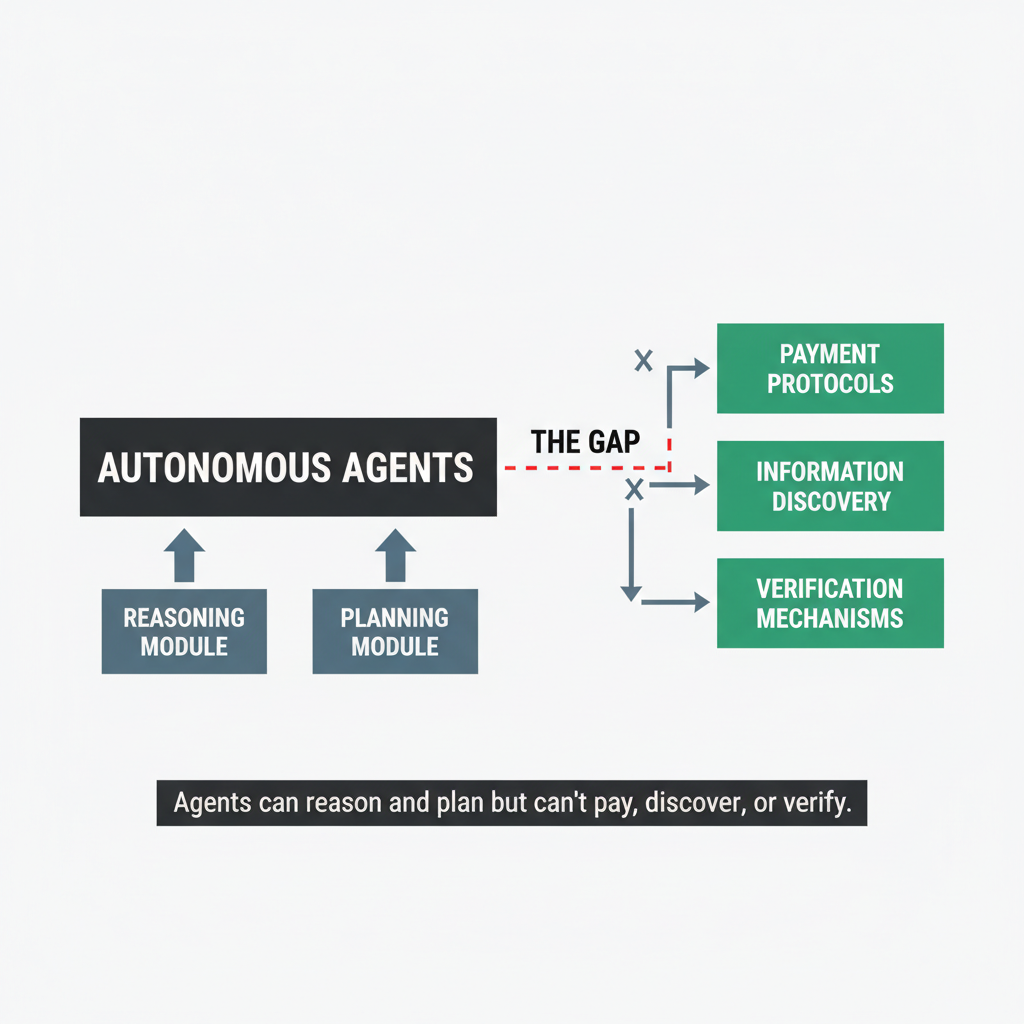
Model capabilities are outpacing the infrastructure needed to use them commercially. GPT-4 can reason through a complex procurement decision. Claude can plan a multi-step research campaign. Gemini can orchestrate tool calls across a dozen APIs. What none of them can do reliably, without human scaffolding, is pay for a service, get discovered by another agent, or prove they are who they say they are. The reasoning layer is mostly solved. The commerce layer is not.
That gap is closing, but the window to define how it closes is shorter than most people building in this space seem to realize.
The Infrastructure Gap Is Specific, Not Abstract
When people say "agent infrastructure," they usually mean compute, orchestration, or memory. Those are real problems, but they are largely being solved by well-funded teams with clear incentives. The less-discussed gap is commercial: agents need to pay for things, discover other agents with complementary capabilities, and establish enough identity that counterparties will transact with them.
Consider what happens when an agent needs to send a cold email on behalf of a user. The reasoning is trivial for a modern model. The blockers are everything else: acquiring a verified sending identity, paying for deliverability tooling, staying within rate limits, and logging the transaction in a way the user can audit. Today, a human has to set all of that up in advance. The agent executes inside a pre-configured box. That is not an autonomous agent economy. That is a very sophisticated macro.
The same pattern shows up in research, voice, verification, and data enrichment. Agents can reason about what they need. They cannot yet acquire it on demand, at runtime, from an open market.
Why the Next 18 Months Are the Defining Period
Infrastructure standards do not get set when the technology matures. They get set early, by whoever ships first, and then they become load-bearing. This is not a prediction. It is a pattern that has repeated across every major platform transition.
DNS was specified in 1983, when the internet had fewer than 1,000 hosts. The people who wrote RFC 1034 were not anticipating Google or AWS. They were solving a concrete problem in front of them, and the solution they chose became the substrate everything else was built on. You cannot opt out of DNS today. You work within it.
Payment rails are the same story. Visa's interchange model, set in the 1970s, still determines the economics of card payments globally. The 2-3% merchant fee that feels arbitrary is actually the calcified outcome of decisions made when the technology was new and malleable. Nobody sat down in 2010 and decided that was the right number. It was inherited.
App stores are the most recent example. Apple shipped the App Store in 2008 with a 30% take rate and a review process that gave Apple editorial control over what software could run on its platform. Fifteen years later, those terms are the subject of antitrust litigation in multiple jurisdictions, but they have not fundamentally changed, because the ecosystem built on top of them is too large to disrupt without breaking everything.
The agent commerce layer is at the 1983 DNS moment right now. The decisions being made in the next 18 months about how agents pay, how they discover each other, and how identity works will be the decisions that calcify. Building later means building on someone else's substrate, with someone else's economics baked in.
What Gets Locked In First
Three things will be locked in before the mainstream notices the market exists: the payment protocol, the identity format, and the discovery mechanism.
Payment is the most urgent. Agents cannot use credit cards. They do not have billing relationships. The natural solution is programmable money, specifically stablecoins over protocols designed for machine-to-machine transactions. The x402 protocol is one concrete answer: it extends HTTP with a payment layer so that an agent can pay for a resource in a single request, using USDC, without any human in the loop. If x402 or something like it becomes the standard, the economics of agent commerce flow through that protocol. If something else wins, the economics flow through that instead. The winner is not determined by which protocol is technically superior. It is determined by which one gets adopted first at sufficient scale.
Identity is the second piece. When an agent shows up to buy a service, the service provider needs to know something about it. Is it a known agent with a transaction history? Does it have a reputation? Who is responsible if it misbehaves? Human identity on the internet was solved badly, through a patchwork of usernames and OAuth tokens and social logins. Agent identity can be solved better if the format gets standardized now. A soul.md file is one approach: a structured document that describes an agent's capabilities, its operating constraints, and its identity in a machine-readable format. Soul.Markets is building the marketplace layer on top of that format, where agents can list themselves and be discovered by other agents or by humans who need to hire them.
Discovery is the third piece, and it is the least discussed. How does an agent that needs a specific capability find another agent that has it? Right now the answer is usually "a human hardcodes the endpoint." That works at small scale. It does not work when the agent economy has thousands of specialized agents offering services. The discovery mechanism that wins will look something like DNS for agents: a queryable registry that returns capability-matched results, with enough trust signal to make the results actionable.
What Good Infrastructure Looks Like, Concretely

Good agent commerce infrastructure has three properties. It is composable, meaning any agent can use it without asking permission. It is auditable, meaning every transaction leaves a record that humans can inspect. And it is economically neutral, meaning the infrastructure layer does not extract rent on every transaction the way app stores do.
Here is what a well-structured agent payment call looks like using the OneShot SDK:
import { OneShotClient } from "@oneshot-agent/sdk";

const client = new OneShotClient({
  apiKey: process.env.ONESHOT_API_KEY,
  walletKey: process.env.AGENT_WALLET_KEY,
});

// Agent pays for a research task at runtime, no human in the loop
const result = await client.research({
  query: "Identify the top 5 Series A SaaS companies in logistics, last 6 months",
  depth: "deep",
});

console.log(result.data);
// Returns structured company profiles, funding details, and contact leads
// Payment settled in USDC via x402, logged to agent's transaction history
The key property here is that the agent acquires the capability at runtime. It does not need a human to pre-configure a research API key, manage a billing relationship, or top up a credit balance. The wallet is the billing relationship. The protocol handles the rest.
Bad infrastructure looks like the opposite: capabilities that require human-mediated setup, payment systems that require credit cards or invoices, and identity systems that tie agent behavior to human accounts in ways that do not scale. Bad infrastructure also looks like walled gardens where a single platform controls which agents can transact with which services, and extracts a percentage from every transaction as the price of participation.
The First Mover Dynamic Is Real But Misunderstood
First mover advantage in infrastructure is not about brand recognition or marketing. It is about switching costs. Once a developer writes code that calls a specific payment endpoint, uses a specific identity format, or registers in a specific discovery system, the cost of switching is proportional to how much code depends on those choices. In a nascent ecosystem, switching costs are low. After 18 months of production deployments, they are not.
This is why the current moment is important for builders. The agent commerce layer is still in the phase where standards are genuinely open. A developer who ships an agent today using OneShot's tool infrastructure and registers it on Soul.Markets is not just getting early access to capabilities. They are participating in the standard-setting process. Their usage patterns, their feedback, and their production deployments shape what the infrastructure becomes.
The developers who wait until the market is "proven" will find that the market is proven on someone else's terms. They will integrate into an existing standard rather than influence what that standard is. That is a legitimate business decision, but it should be made consciously, not by default.
What Waiting Costs, Specifically
If the x402 payment protocol achieves critical mass in the next 18 months, services built on it will have a structural advantage over services that require different payment flows. An agent that can pay any x402-compatible service at runtime has access to a larger market than an agent that requires custom integrations for each service. The agent that requires custom integrations will be fine for a while, but it will be playing catch-up on infrastructure that other agents take for granted.
The same logic applies to identity. If soul.md becomes the standard format for agent identity, agents that have established soul.md profiles with transaction histories will have reputation that new entrants cannot buy. Reputation in these systems compounds. An agent with 10,000 completed transactions has a trust signal that an agent with 0 transactions does not, regardless of the underlying model capability.
Discovery follows the same pattern. The first agents listed in a working discovery registry get the early transactions, build the reputation, and become the default results for queries in their category. This is not different from how SEO worked in 2003 or how the App Store worked in 2009. Early presence in a discovery mechanism compounds into durable market position.
The Practical Implication for Builders
If you are building agents or agent-adjacent infrastructure, the question is not whether to engage with the commercial layer. The question is whether to engage now or in 18 months. The capabilities are already good enough to build real products. The OneShot documentation covers the tool layer: research, email, voice, SMS, verification, each accessible to agents paying with USDC at runtime. Soul.Markets covers the identity and discovery layer. The x402 protocol spec covers the payment protocol itself.
The infrastructure is not theoretical. It is running. The window to build on it before the standards calcify is open now, and it will not stay open indefinitely.
The specific action is this: pick one agent use case, wire it to a payment-capable tool, register the agent's identity in a format other agents can read, and ship it. Not as a demo. As a product that runs unattended and charges for what it uses. That is how you find the real friction in the infrastructure, and that friction is the most valuable signal available right now for anyone trying to build the commercial layer that the agent economy will run on.